

How French Language Is Dying
The French language has long been regarded as one of the world’s most beautiful and influential languages. It has shaped literature, philosophy, diplomacy, art, and international relations for centuries. Once considered the primary language of diplomacy and culture, French was spoken widely across Europe and in many colonies around the world. However, in recent decades, concerns have grown about the declining influence of French on the global stage. Many linguists, educators, and cultural observers argue that French is gradually losing its dominance and dying due to globalization, technological change, and the rise of English as the world’s primary international language. As a result, discussions about the future of French language have become increasingly important.
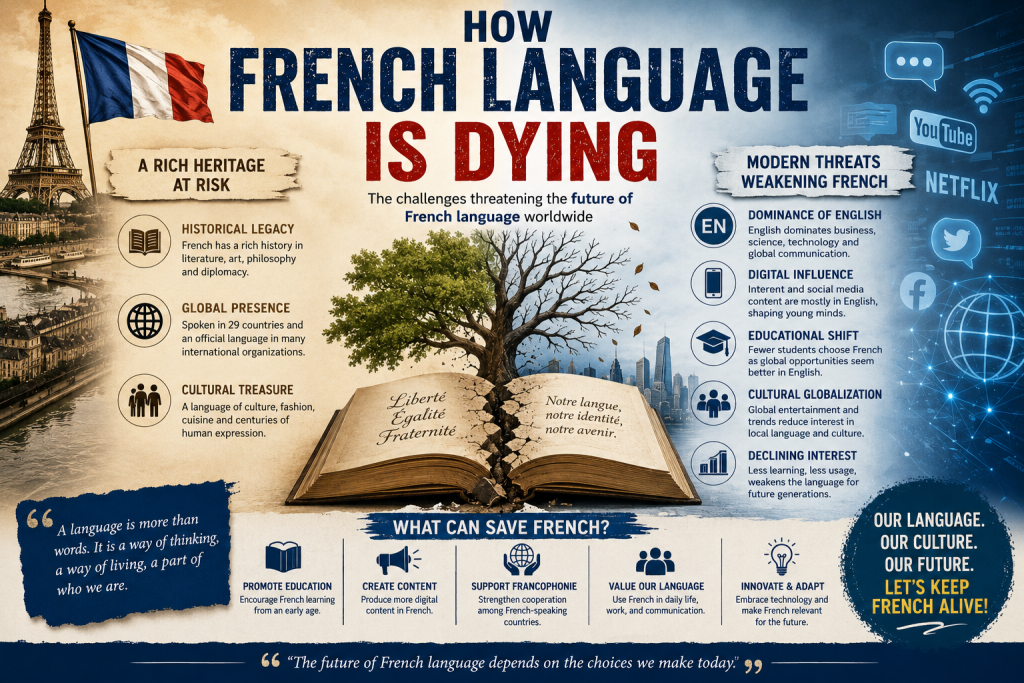
Dominance of English and decline of French language
One of the main reasons for the decline of French is the overwhelming influence of English. Today, English is the dominant language of international business, science, technology, entertainment, and higher education. People seeking global career opportunities often prioritize learning English over French. Major corporations conduct business primarily in English, and most scientific research papers are published in English. This trend has reduced the practical necessity of learning French, especially among younger generations who are focused on global communication.
The digital revolution has also contributed to the weakening position of French. The internet is heavily dominated by English-language content. Websites, social media platforms, software applications, and online educational resources are often created first in English. Although French content exists online, it represents only a small portion of the internet compared to English. Young people spend a significant amount of time consuming digital content, and their exposure to English vocabulary continues to increase. This constant exposure influences speech patterns and often leads to the adoption of English words and expressions in everyday French conversations.
Cultural Globalization
Another factor affecting the future of French language and leading towards it dying is cultural globalization. International movies, television series, music, and video games are largely produced in English-speaking countries. Global entertainment industries have helped spread English expressions and cultural references worldwide. Many French-speaking youths prefer consuming English-language media, which can weaken their connection to traditional French literature and culture. Over time, this shift may reduce interest in preserving the linguistic purity and uniqueness of French.
Diversity and its affects
Immigration and multiculturalism have also changed language dynamics in many French-speaking regions. Countries such as France, Canada, Belgium, and Switzerland have become increasingly diverse. While diversity brings many benefits, it also creates environments where multiple languages coexist. In some urban areas, French competes with other widely spoken languages. As societies become more multilingual, the exclusive role of French may gradually diminish.
Education systems face challenges as well. In several countries where French was historically taught as a second language, educational priorities have shifted toward English and other emerging languages such as Mandarin Chinese. Students often choose languages that they believe will provide better economic opportunities. Consequently, enrollment in French language programs has declined in some regions. This trend raises concerns among educators about the future of French language and its ability to attract new learners.
Despite these challenges, it would be inaccurate to claim that French is disappearing completely. French remains one of the most widely spoken languages in the world, with millions of speakers across Europe, Africa, North America, and parts of Asia. It is an official language of numerous international organizations, including the United Nations and the European Union. Additionally, many African countries continue to use French as a key language for education, government, and communication. These factors provide a strong foundation for the language’s survival.
However, survival alone is not the same as maintaining influence. The concern is not necessarily that French will vanish, but that it may become less significant in global affairs compared to previous centuries. Governments and cultural institutions have recognized this issue and have launched initiatives to protect and promote French. Organizations such as the International Organization of La Francophonie encourage the use of French worldwide and support educational programs aimed at strengthening French-speaking communities.
Preserved on internet alone
Technology may also play a role in preserving the language. Translation tools, language-learning applications, and digital content creation can help expand access to French. By embracing innovation rather than resisting it, French-speaking communities may find new ways to engage younger generations. The success of these efforts will have a significant impact on the future of French language.
Coclusion
In conclusion, the French language faces serious challenges from globalization, the dominance of English, technological changes, and shifting educational priorities. These factors have led many observers to believe that French is gradually losing its global influence. Nevertheless, French remains a major international language with a rich cultural heritage and millions of speakers worldwide. The debate about the future of French language is not simply about whether the language will survive, but whether it can maintain its relevance and prestige in an increasingly interconnected world. The actions taken today by governments, educators, and French-speaking communities will determine whether French continues to thrive or slowly fades from its historic position of prominence.